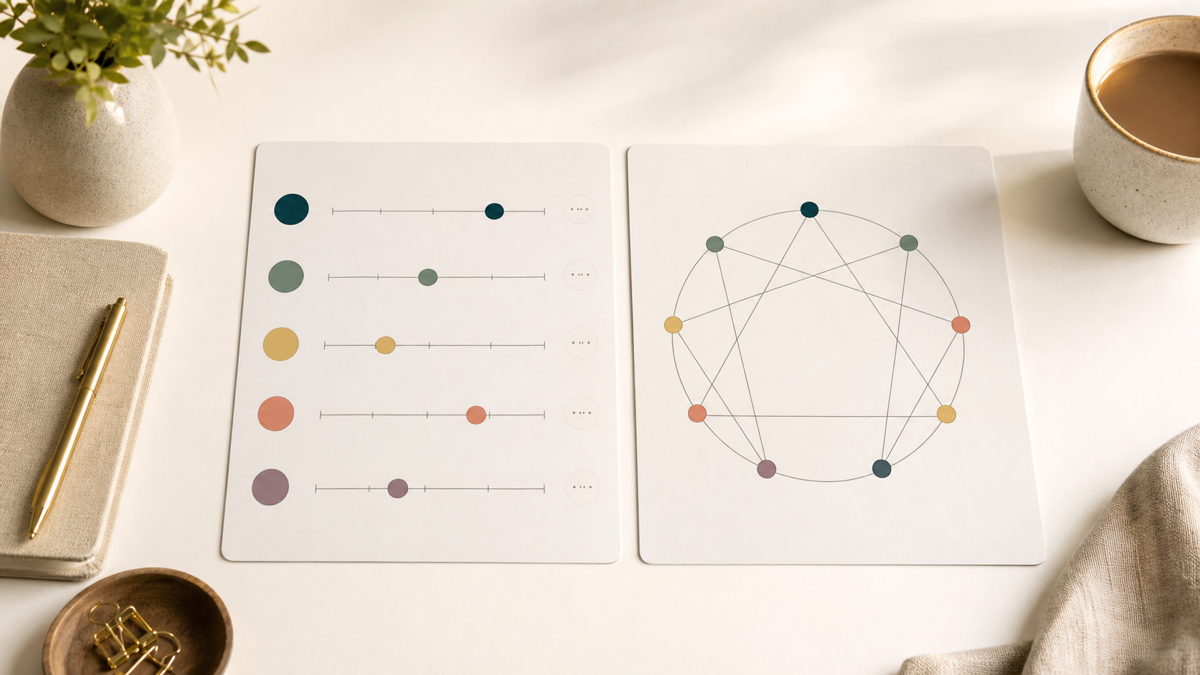
Valid Big Five Personality Test or Enneagram Test: What To Trust
A valid Big Five personality test should measure the five OCEAN traits clearly, score them consistently, and avoid turning a single result into a diagnosis or fixed identity. The Big Five model has stronger research support than most type-based systems, but that does not automatically make every free online Big Five test scientifically validated. A good test should explain what it measures, how results are scored, and how much caution to use when reading them.
The Enneagram serves a different purpose. It is better treated as a reflective framework for motivation patterns than as a scientifically validated trait measure. That does not make it useless. It does mean readers should choose the test that fits the question they are asking.
Big Five validity starts with the model, not the result page
When people search for a valid Big Five personality test, they are usually trying to avoid vague quizzes. They want something more grounded: a test that reports Openness, Conscientiousness, Extraversion, Agreeableness, and Neuroticism rather than a flattering label with no clear basis.
The Big Five is often a sensible first stop because it describes broad trait dimensions. Someone can be high, low, or somewhere in the middle on each trait. That is different from being sorted into one type. A Big Five result can say, for example, that a person scores higher on Conscientiousness and lower on Extraversion without claiming those scores explain everything about them.
PersonalityMe’s Free Big Five Personality Test | OCEAN Trait Scores uses 50 items to return scores across the five OCEAN traits. The linked Free Big Five Personality Test Guide | OCEAN Traits explains the trait domains, score bands, reverse scoring, and how those results should be read. Item count can help with coverage, but it is not proof of validity on its own. Better questions, consistent scoring, reliability, validity evidence, and careful interpretation all matter.
Reliability and validity are not the same thing
Two terms matter when judging any personality assessment.
Reliability means the test is consistent. If a person takes a well-built measure again under similar conditions, the result should not swing wildly for no good reason. Reliability is about measurement stability and internal consistency.
Validity asks whether the test measures what it claims to measure. A test can be consistent and still miss the target. For example, a quiz might reliably group people into categories, but that does not prove the categories capture real personality traits in a useful way.
This distinction is why “scientifically validated” should be read carefully. The Big Five model is well established as a trait framework, but a specific online test needs its own evidence before it can claim full scientific validation. If that evidence is not shown, the safer wording is that the test is based on Big Five theory, not that the test itself has been independently validated.
Where the Enneagram fits beside Big Five
The Enneagram looks at nine motivational patterns. It asks a different kind of question from the Big Five. Instead of describing broad trait levels, it tries to identify a likely core type, related wings, and patterns around attention, fear, desire, strengths, and growth.
That makes it useful for reflection. Someone who already knows they score high on Agreeableness may still want to understand whether their helpfulness comes from connection, duty, conflict avoidance, image, or another motive. That is the kind of question an Enneagram result can help explore.
It should not be treated as the same kind of evidence as a Big Five trait score. PersonalityMe’s Big Five vs Enneagram: Differences, Uses, and Limits comparison is useful here because it separates traits from motivation patterns. For readers choosing between tests, that distinction matters more than which label feels more interesting.
A practical trust check before taking any free test
A polished interface can make a weak assessment feel more credible than it is. Before trusting a result, look for signals that the test is clear about what it can and cannot tell you.
| What to check | Why it matters |
|---|---|
| The test names the model it uses | Big Five, Enneagram, 16-Type, and RIASEC measure different things. |
| It explains the result format | Trait scores, type rankings, and interest profiles should not be read in the same way. |
| It avoids overclaiming | A result should not diagnose, predict your future, or reduce you to one label. |
| It separates model evidence from test evidence | A research-supported model does not validate every online implementation. |
| It gives enough detail to interpret uncertainty | Top scores, score gaps, and close alternatives can matter as much as the headline result. |
For a broader choosing guide, PersonalityMe’s Free Online Personality Test | Big Five, OCEAN Traits and What to Trust explains how to match a free test to the question being asked. The main point is simple: take the assessment that fits the job. Big Five is usually better for trait measurement. Enneagram is usually better for exploring recurring motivations and self-reflection prompts.
Reading an Enneagram result without pretending it is a lab report
A careful Enneagram result should feel like a starting point, not a verdict. PersonalityMe’s Enneagram assessment uses 90 prompts and returns a likely core type, top-three ranking, score gap, possible wing candidates, strengths, and growth prompts. That extra context matters because close scores can change how confidently someone should read the top type.
If Type Three and Type One are close, for instance, the reader should compare the underlying motivations rather than accept the first label without question. If a wing candidate appears, it should be read as a nearby flavour of the core pattern, not as a second personality.
The Free Online Enneagram Test | Find Your Likely Core Type guide gives more detail on reading likely core type, top scores, wings, and limits. That framing is healthier than using the Enneagram as proof of who someone is. It turns the result into a prompt for reflection: what pattern fits under pressure, in relationships, and when making choices?
Choosing the right PersonalityMe assessment
PersonalityMe brings several free assessments together in one place, including 16-Type, Big Five, Enneagram, and RIASEC. The best first choice depends on the reader’s aim.
If they want a trait-based personality profile, start with Big Five. If they want a motivation-focused lens, take Enneagram. If they are comparing frameworks and feeling unsure, the main Free Personality Tests: 16-Type, Big Five, Enneagram & RIASEC page gives a clean route into each assessment.
The most useful approach is often sequential. A reader might take Big Five first to understand broad trait tendencies, then take Enneagram to explore recurring motives behind similar behaviour. Those results should be compared thoughtfully. They are different lenses, not rival verdicts.
Questions careful test-takers usually ask
Is a free Big Five test valid?
Some free Big Five tests may be built on sound trait theory, but that is not the same as proving the specific test is scientifically validated. Look for clear scoring, careful wording, reliability or validity evidence where available, and modest interpretation.
Is the Enneagram scientifically validated like the Big Five?
No. The Enneagram is better treated as a reflective model for motivation patterns. It can be useful for self-observation, but it should not be presented as having the same research standing as the Big Five trait framework.
Does a longer personality test mean it is more accurate?
Not automatically. More items can improve coverage, but only if the items are well written and scored consistently. A longer test with vague questions can still produce weak results.
Should someone take Big Five or Enneagram first?
For a more research-aligned trait profile, Big Five is the better first step. For exploring likely core motivations and recurring patterns, Enneagram is the better fit. Many readers benefit from taking both and comparing the results cautiously.
A good result should help a person notice patterns without trapping them inside a label. Readers who want the motivation-focused lens can take PersonalityMe’s Free Enneagram Test | Find Your Likely Core Type and read the top scores, score gap, and wing candidates as prompts for careful self-reflection.