Free Online Personality Test: What to Take and What to Trust
A free online personality test can be useful when it gives a clear result, explains what it measures, and avoids pretending to diagnose or predict everything about a person. For most readers, the safest place to start is a Big Five personality test, because the Big Five model is one of the better-supported ways to describe broad personality traits. That does not automatically make every online Big Five test scientifically validated, but it does give the reader a stronger framework than many vague personality quizzes.
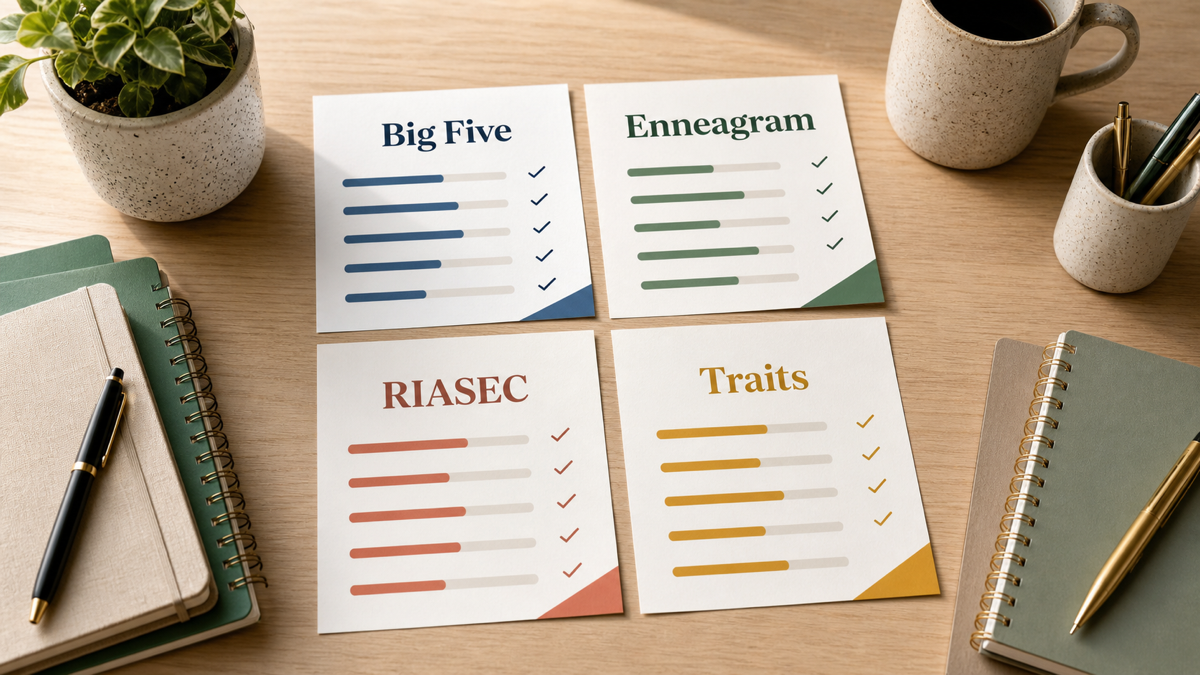
PersonalityMe offers several free assessments in one place, including 16-Type, Big Five, Enneagram, and RIASEC. The best choice depends on what the reader wants to understand: trait patterns, type preferences, motivation, or career interests. If the goal is a grounded first read on personality, Big Five is usually the cleanest starting point.
A useful personality test should say what it is measuring
The phrase personality test covers several different kinds of assessment. Some tests sort people into types. Some score people on trait dimensions. Others focus on motivation, work interests, or behaviour patterns. These can all be interesting, but they are not interchangeable.
The Big Five describes personality through five broad domains, often called the OCEAN traits: Openness, Conscientiousness, Extraversion, Agreeableness, and Neuroticism. A Big Five result does not say someone is one fixed type. It shows where their answers sit across five dimensions. That makes it easier to see mixed patterns, close scores, and trade-offs.
A 16-Type assessment works differently. It usually groups preferences into four pairs, then combines those preferences into a four-letter type. PersonalityMe’s Free 16-Type Personality Test Guide | PersonalityMe explains how those preference pairs shape the final result. This can be a helpful lens for communication style and decision-making preferences, but it should not be treated as a full scientific profile of a person.
The Enneagram is different again. It looks more at core motivations and recurring patterns than trait levels. RIASEC focuses on career interests rather than personality in the broad sense. For readers who want to compare these lenses before choosing, PersonalityMe’s Compare Personality Tests: 16-Type, Big Five, Enneagram & RIASEC page sets the main assessment types side by side.
Why the Big Five is often the best first test
The Big Five model has stronger research support than many popular personality systems. That statement is about the model itself, not a blanket guarantee for every free online test using Big Five language. A scientifically validated Big Five test needs more than familiar trait names. It needs well-written items, consistent scoring, evidence that the scores behave as intended, and interpretation that stays within what the test can support.
This is where readers should separate two claims. One claim is that Big Five traits are a widely used model for describing personality differences. That is well supported at the model level. The other claim is that a particular online test has been validated with published evidence. That needs specific proof from the test provider. If that evidence is not supplied, it is better to treat the result as a useful self-reflection tool rather than a formal psychological measurement.
PersonalityMe’s Free Big Five Personality Test Guide | OCEAN Traits explains the five domains and how they appear in a result. The guide is useful because it keeps the focus on interpreting scores, not turning a test report into a verdict.
What to check before trusting a free test result
A free test does not need to be shallow. It also does not become reliable just because it has many questions. Item count can improve coverage, but only if the items are clear, relevant, and scored consistently.
| What to look for | Why it matters |
|---|---|
| Clear model | The test should say whether it uses Big Five, 16-Type, Enneagram, RIASEC, or another framework. |
| Transparent result format | The reader should know whether they will receive trait scores, a type, a ranked list, or career-interest themes. |
| Careful interpretation | Good reports explain patterns and limits instead of making sweeping claims. |
| Close-score handling | If two scores are near each other, the result should not pretend the difference is absolute. |
| No overreach | A personality result should not diagnose mental health, decide hiring outcomes, or define someone’s future. |
| Evidence language | Claims about scientific validity should be specific, not vague or promotional. |
Two terms help here: reliability and validity. Reliability is about consistency. If a person takes a test again in similar conditions, a reliable measure should not swing wildly without reason. Validity is about whether the test measures what it claims to measure. A test can be consistent without being meaningful, so reliability alone is not enough.
Validity also depends on use. A casual self-reflection test may be useful for noticing patterns in work style or relationships. That does not mean the same result is valid for clinical decisions, recruitment decisions, or high-stakes assessment.
How to read your result without over-reading it
A personality report works best as a structured mirror. It can help someone notice tendencies that are easy to miss from the inside: avoiding conflict, seeking novelty, preferring closure, needing recovery time after social intensity, or finding motivation through personal meaning rather than external approval.
It works less well when the reader treats the result as a fixed identity. A high Conscientiousness score might suggest someone tends to organise, plan, and follow through. It does not mean they are always productive, never flexible, or automatically suited to every detail-heavy role. A lower Extraversion score may point towards more selective social energy. It does not mean the person dislikes people.
The same caution applies to type-based results. A 16-Type result can provide memorable language for preferences, but the four-letter code should not flatten someone’s behaviour into a script. PersonalityMe’s article on What Your Personality Test Can Tell You, and What It Cannot is a useful companion after taking any assessment, especially if the result feels surprisingly accurate or slightly off.
The best reading habit is to ask: does this describe a recurring pattern, or just one current mood? Self-report tests are influenced by stress, context, recent experiences, and how honestly someone answers. A result is stronger when it matches repeated behaviour across different settings.
Choosing between Big Five, 16-Type, Enneagram, and RIASEC
Someone searching for a free online personality test may not know which assessment they actually want. The right starting point depends on the kind of answer they are looking for.
If the reader wants trait scores, Big Five is the most direct option. It gives a profile across OCEAN traits rather than forcing one overall type. That makes it useful for people who want nuance.
If the reader wants an accessible type label, 16-Type may feel more intuitive. It is often used for understanding preference patterns in communication, planning, and decision-making. The result can be memorable, but it should be read as a lens rather than a complete personality map.
If the reader is exploring motivation and recurring emotional patterns, the Enneagram may feel more relevant. It can be useful for reflection, though it is not the same kind of measurement model as Big Five.
If the reader is thinking about work fit, RIASEC is a career-interest assessment. It is less about personality traits and more about the kinds of activities, environments, and work themes that may feel engaging.
PersonalityMe’s homepage brings these options together under Free Personality Tests: 16-Type, Big Five, Enneagram & RIASEC, so readers can choose the lens that fits the question they are trying to answer.
Common questions before taking a free personality test
Is a free online personality test accurate?
It can be useful, but accuracy depends on the model, item quality, scoring, and interpretation. A free test can support reflection when it is transparent and careful. It should not be treated as a diagnosis or a complete description of someone’s character.
Is the Big Five scientifically valid?
The Big Five model is well supported as a broad framework for describing personality traits. That is different from saying every Big Five quiz online has been scientifically validated. For a specific test, look for evidence about reliability, validity, scoring, and how the test was evaluated.
How many questions should a personality test have?
There is no single correct number. More items can help cover a trait more fully, but item count is not proof of quality. A shorter test with clear items and cautious interpretation may be more useful than a longer test with vague statements.
Which free test should someone take first?
For a grounded first pass, Big Five is usually a strong choice because it returns trait scores across OCEAN domains. Someone who wants a type code may prefer 16-Type, while someone exploring motivation may prefer the Enneagram.
A personality test is most useful when the reader knows what kind of answer they want and reads the report with sensible limits. To start with a trait-based result and see OCEAN scores across five broad domains, take PersonalityMe’s Free Big Five Personality Test | OCEAN Trait Scores.