Free Personality Traits Test: 16-Type, Big Five, Enneagram and RIASEC
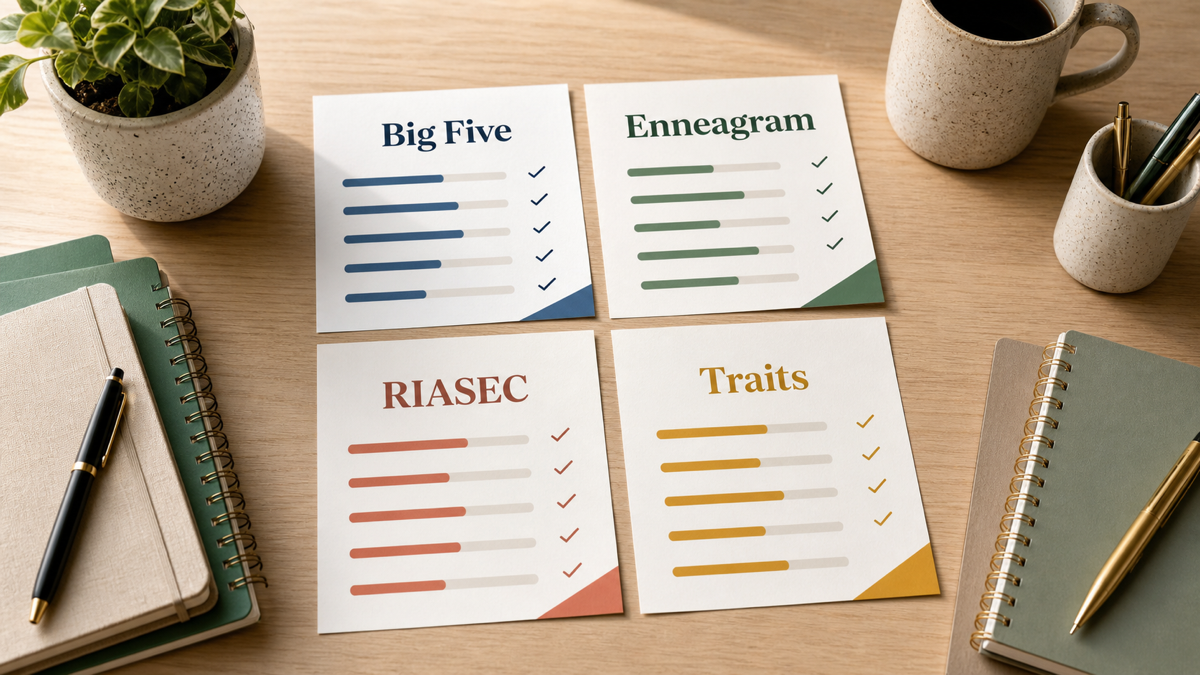
A free personality traits test is most useful when it tells you exactly what it measures. Big Five tests measure broad trait scores, 16-Type tests group preferences into a type code, Enneagram tests look at motivation patterns, and RIASEC tests focus on career interests. If someone wants the strongest starting point for trait-based self-understanding, Big Five is usually the clearest first choice because it reports scores across the OCEAN traits rather than placing the whole person into one label.
That does not mean every online Big Five personality test is scientifically validated. The model has stronger research support than many popular personality frameworks, but a specific test still needs good items, consistent scoring, reliability, validity, and careful interpretation.
The four free tests answer different questions
PersonalityMe brings 16-Type, Big Five, Enneagram, and RIASEC into one place because people often want more than one kind of answer. The mistake is treating every result as if it explains the same thing.
A 16-Type result is useful when someone wants a compact preference pattern. It can help describe how a person tends to take in information, make decisions, and approach the outer world. It is easy to remember and easy to compare, but the type code can feel too neat if the reader expects precise trait measurement.
The Big Five is better suited to people searching for a personality traits test. It describes Openness, Conscientiousness, Extraversion, Agreeableness, and Neuroticism as dimensions. A person does not become one type. They receive a pattern of scores. That makes it easier to see nuance, such as being highly conscientious but only moderately extraverted.
The Enneagram is different again. It looks at likely motivation patterns, not just visible behaviour. A result can be useful for reflection, especially when someone is trying to understand recurring fears, wants, and stress habits. PersonalityMe's guide to a Free Online Enneagram Test | Find Your Likely Core Type explains how to read those results without treating them as a fixed identity.
RIASEC is the most career-oriented of the four. It focuses on interest areas rather than personality in the everyday sense. It can help someone compare the kinds of tasks, environments, and work themes they may find engaging.
Why Big Five is usually the best first traits test
For a reader who searched for a free personality traits test, Big Five is the most direct match. It is built around trait dimensions, and those dimensions are easier to compare across people, situations, and time than a single type label.
The OCEAN traits cover broad patterns:
| Trait | What it broadly describes | A result can help with |
|---|---|---|
| Openness | Curiosity, imagination, and interest in new ideas | Understanding novelty, creativity, and preference for variety |
| Conscientiousness | Structure, follow-through, and self-discipline | Reading work style, planning habits, and consistency |
| Extraversion | Sociability, energy, and stimulation seeking | Seeing how social settings may affect energy and expression |
| Agreeableness | Cooperation, trust, and concern for others | Reflecting on conflict style and interpersonal warmth |
| Neuroticism | Emotional sensitivity and stress reactivity | Noticing worry, pressure response, and emotional volatility |
This is why many readers start with PersonalityMe's Free Big Five Personality Test Guide | OCEAN Traits before taking the assessment. The guide explains the five domains and the result format, which makes the scores easier to interpret.
What scientific validity can and cannot tell you
Scientific-sounding language can make a test feel more trustworthy than it is. A polished result page is not the same as a validated measurement tool.
The Big Five model has stronger model-level support than many popular personality systems. That is a statement about the framework, not a guarantee about every free online test using Big Five language. A specific test needs its own evidence before it should be called scientifically validated.
Reliability means the test measures consistently. If a person takes the same assessment again under similar conditions, the result should not swing wildly without a real reason. Validity means the test measures what it claims to measure. A test can be reliable without being valid: it may produce consistent scores, but those scores might not represent the trait well.
Item count can help coverage, but it is not proof. A 50-item assessment may cover more ground than a very short quiz, yet item quality, scoring consistency, reliability, validity, and interpretation all matter. A careful reader should look for what the test measures, how results are reported, and whether the language avoids overclaiming.
PersonalityMe should keep this distinction clear on any refreshed page: Big Five has stronger model-level support, while the PersonalityMe assessment should be presented as a free Big Five assessment unless separate validation evidence is available.
How to choose between 16-Type, Big Five, Enneagram, and RIASEC
The right assessment depends on the question the reader is asking.
Choose Big Five if the goal is to understand broad personality traits. It is the most natural fit for OCEAN trait scores, trait comparison, and careful self-reflection.
Choose 16-Type if the goal is a memorable preference profile. It can be useful for comparing broad patterns, especially when someone already knows type language and wants a compact result.
Choose Enneagram if the goal is to think about motivation and recurring internal patterns. It is better treated as a reflective lens than as a clinical or scientific verdict.
Choose RIASEC if the question is about career interests. It is less about personality as a whole and more about the work themes someone may prefer.
Readers who are unsure can use PersonalityMe's Compare Personality Tests: 16-Type, Big Five, Enneagram & RIASEC page to see how the assessments differ before choosing one. More focused comparisons can also help: 16-Type vs Big Five: Differences, Uses, and Limits explains the difference between a type code and trait scores, while Big Five vs Enneagram: Differences, Uses, and Limits separates trait measurement from motivation patterns.
A simple checklist before trusting a free result
A free test can still be useful. The reader just needs to know what kind of usefulness it offers.
Before taking a result too seriously, check whether the test:
- Names the model it is based on, such as Big Five, 16-Type, Enneagram, or RIASEC.
- Explains what the scores or types mean in plain English.
- Separates trait scores from identity labels.
- Avoids claiming to diagnose, predict a whole life path, or explain every behaviour.
- Makes room for context, mood, age, culture, and changing circumstances.
- Uses result language that helps reflection rather than boxing the reader in.
This is also where a strong homepage refresh can help. The PersonalityMe homepage already introduces the four assessment lenses. It can work harder for searchers by making the test choice clearer near the top, adding a concise explanation of trait testing, and linking directly to the Big Five assessment for readers who came looking for a free personality traits test.
Common questions about free personality traits tests
Is Big Five the same as a personality traits test?
Big Five is one of the clearest examples of a personality traits test because it measures broad dimensions rather than assigning one type. The five domains are Openness, Conscientiousness, Extraversion, Agreeableness, and Neuroticism.
Is a free Big Five personality test scientifically validated?
The Big Five model has stronger research support than many popular personality frameworks. That does not automatically validate every free test that uses Big Five terms. A specific test needs evidence for reliability, validity, scoring quality, and interpretation before it should be described as scientifically validated.
Should someone take Big Five or Enneagram first?
If the goal is trait scores, start with Big Five. If the goal is reflection on motivations and recurring emotional patterns, Enneagram may be useful. Many people take both, then compare the results carefully rather than forcing them to say the same thing.
Can a personality test change over time?
Yes. Results can shift because people change, situations change, and answers may reflect recent stress, work demands, relationships, or mood. A good result is a snapshot of current patterns, not a permanent label.
The most useful next step is a trait score, not a label
For someone looking for a free personality traits test, the practical next step is to start with Big Five, read the OCEAN scores carefully, and treat the result as a structured reflection rather than a verdict. PersonalityMe's assessment is built for that starting point: Free Big Five Personality Test | OCEAN Trait Scores.