Personality Traits Test: What It Measures and How to Choose One
A personality traits test measures recurring patterns in how a person tends to think, feel, act, and respond across situations. The most useful starting point for many people is a Big Five personality test, because the Big Five model describes personality through five broad trait dimensions rather than forcing every person into a single fixed type.
That does not mean every online test is equally strong. The Big Five model has stronger research support than most popular personality frameworks, but a specific online questionnaire still needs good questions, consistent scoring, careful interpretation, and clear limits. A good result should help someone describe patterns, not hand them a permanent label.
A traits test should measure patterns, not decide who someone is
The word “traits” matters. A traits test is not trying to find one hidden identity inside a person. It is looking for tendencies that show up often enough to be useful: how curious someone tends to be, how organised they are, how much social stimulation they seek, how cooperative they are, or how strongly they react to stress.
That is why trait-based results usually work better as ranges than verdicts. Someone may score high on conscientiousness and still procrastinate under pressure. Someone may score lower on extraversion and still enjoy a lively dinner with close friends. The result is a signal about typical patterns, not a full biography.
PersonalityMe’s guide to choosing a traits test makes the same distinction: a useful assessment should be clear about what it measures, how the result should be read, and where the interpretation stops. That matters because people often take personality tests when they are trying to make sense of work habits, relationships, stress, career fit, or self-development. The stakes are practical, even when the test feels casual.
Why Big Five is usually the cleanest first lens
For someone searching for a personality traits test, the Big Five is often the best first framework to understand. It describes personality through five broad domains, often remembered as OCEAN: Openness, Conscientiousness, Extraversion, Agreeableness, and Neuroticism.
Each domain describes a continuum. Openness is linked with curiosity, imagination, and interest in new ideas. Conscientiousness covers structure, follow-through, and dependability. Extraversion relates to social energy and stimulation. Agreeableness reflects cooperation, warmth, and concern for others. Neuroticism describes sensitivity to stress, emotional reactivity, and worry.
The important distinction is this: the Big Five model is research-supported at the model level. That is different from saying that every Big Five test on the internet is scientifically validated. A short quiz can use Big Five language without measuring the traits well. A longer questionnaire can cover more ground, but item count alone is not proof of quality. The wording of items, the scoring method, consistency across answers, and interpretation all matter.
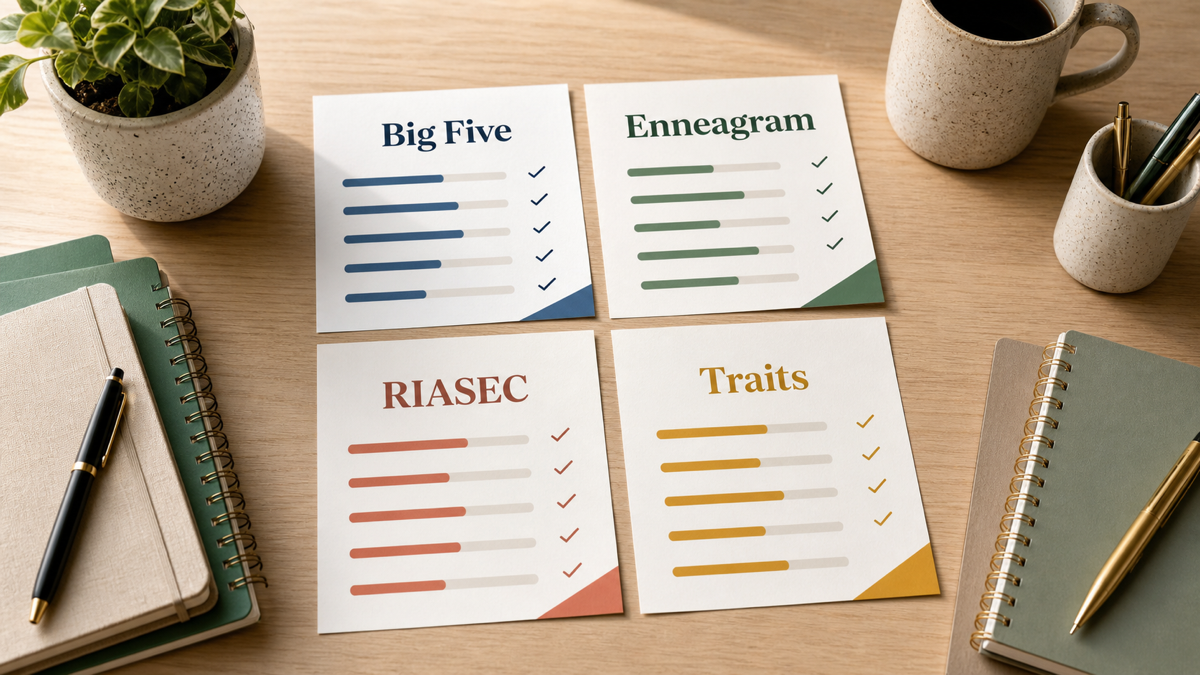
Readers comparing different frameworks can also use PersonalityMe’s assessment comparison guide to see how Big Five differs from 16-Type, Enneagram, and RIASEC. The cleanest choice depends on the question being asked. Big Five is strong for trait patterns. 16-Type focuses on preference pairs. Enneagram is more about motivation. RIASEC is built around career interests.
What a worthwhile personality traits test should show
A polished result page is not the same as a trustworthy assessment. Before putting too much weight on a result, check whether the test gives enough detail to interpret it responsibly.
| What to check | Why it matters |
|---|---|
| It names the framework | A result should say whether it uses Big Five, 16-Type, Enneagram, RIASEC, or another model. |
| It explains the traits | Labels are not enough. The test should define what each score means in everyday terms. |
| It shows score ranges | A 52 and an 88 should not be read as the same kind of result. |
| It avoids fixed identity claims | Good tests describe tendencies, not destiny, talent, morality, or worth. |
| It separates evidence from presentation | Attractive design does not prove scientific validity. |
| It explains limits | A useful test says what it cannot tell someone, especially for hiring, diagnosis, or major life decisions. |
This is also where reliability and validity come in. Reliability means the test measures consistently. If someone takes the same assessment again under similar conditions, the result should not swing wildly for no clear reason. Validity means the test is actually measuring what it claims to measure. A test can be reliable without being valid if it consistently measures the wrong thing.
For online personality tests, both ideas matter. A result that feels accurate is not enough. People are good at finding parts of a description that fit them. A better test gives clear score logic and cautious interpretation, so the reader can decide what is genuinely useful.
Reading a result without over-reading it
The best way to use a personality traits test is to treat the result as structured self-reflection. It can give someone language for patterns they already partly recognise. It can also highlight tensions they may not have named before.
For example, a person with high openness and lower conscientiousness may love exploring ideas but struggle to finish long, routine tasks. That does not mean they are unreliable. It suggests they may need external structure, shorter planning cycles, or work that gives them room to experiment.
Someone with high agreeableness may be good at smoothing conflict but may also delay difficult conversations. Someone with high neuroticism may notice risks quickly, which can be useful in planning, but may also need stronger boundaries around rumination. Someone with lower extraversion may not dislike people; they may simply recover energy in quieter settings.
This is where a trait result becomes useful. It gives a person a more precise way to ask, “Where does this pattern help me, and where does it cost me?” PersonalityMe’s article on what a personality test can and cannot tell you is worth reading alongside any result, especially if the score feels surprisingly accurate or uncomfortably wrong.
When another kind of personality test may fit better
A personality traits test is not always the best answer to every self-knowledge question. If someone wants a broad picture of behavioural tendencies, Big Five is a strong option. If they want a type code they can compare with friends or colleagues, a 16-Type assessment may feel more intuitive. If they are focused on recurring motivations, fears, and interpersonal patterns, Enneagram may be more relevant. If the question is about work interests, RIASEC is usually a better match.
The risk is mixing these lenses as if they all measure the same thing. They do not. A person can be introverted in a 16-Type result, score lower on Big Five extraversion, identify with an Enneagram type shaped by achievement or harmony, and still have a career-interest profile that points toward investigative or social work. Those results may overlap, but they are not interchangeable.
If the aim is simply to start with a credible, readable trait framework, Big Five is the cleaner first choice. If the aim is to explore several systems side by side, PersonalityMe’s page for free personality tests gives access to multiple assessment lenses in one place.
Questions people usually ask before taking one
Is a personality traits test the same as a personality type test?
No. A traits test usually places someone on dimensions, such as low to high extraversion. A type test usually sorts someone into a category, such as a 16-Type result. Trait scores can show more nuance because they preserve degree and range.
Is the Big Five scientifically valid?
The Big Five model has stronger research support than many popular personality frameworks. That is a model-level statement. A specific online Big Five test still needs its own quality checks, including item design, reliability, validity, scoring consistency, and responsible interpretation.
Can a short personality traits test be useful?
It can be useful for light self-reflection, but shorter tests usually cover less detail. A short result should be read as a starting point, not a complete profile. More questions can improve coverage, but only if the questions are well written and scored sensibly.
Should employers use personality traits tests to hire people?
Personality results should be handled carefully in work settings. A general online test is not a hiring instrument by default. It may help with reflection or team conversations, but it should not be treated as a standalone decision tool for selection, diagnosis, or performance prediction.
A sensible next step
A personality traits test is most useful when it gives clear language, avoids overclaiming, and helps the reader connect scores to real patterns. For a grounded starting point, read PersonalityMe’s Free Big Five Personality Test Guide | OCEAN Traits and use it to understand what the five traits measure before putting too much weight on any single score.